A Shift Toward Clarity
Over time, my charts have changed… not because I was searching for something new, but because I was learning what I didn’t need.
At one point, like many traders, I had multiple indicators on my chart. Different EMAs, different signals, each one offering information, but not always clarity. And that’s where the shift began for me.
Because if there’s one thing I’ve learned in trading, it’s this:
Clarity will always outperform complexity.
The goal is not to see more.
The goal is to understand what matters most.
Where My Analysis Begins
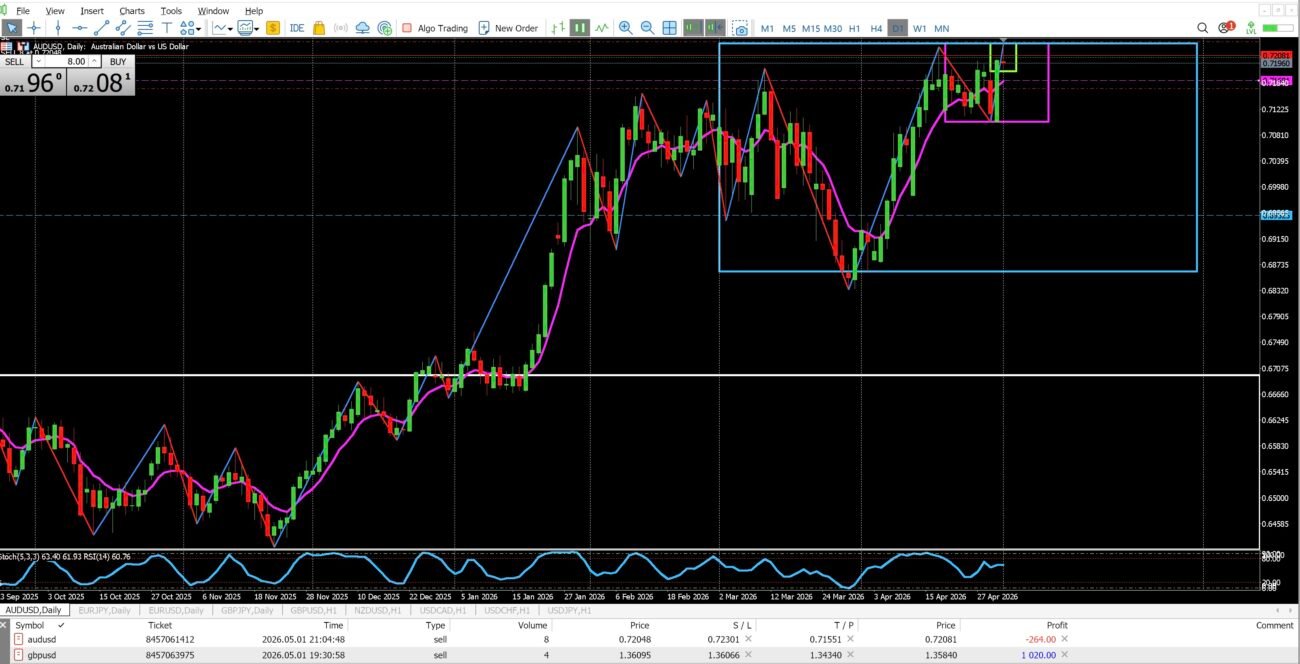
Even though you may see this example on the daily timeframe, my analysis always begins on the 4-hour chart. My purpose for showing the AUDUSD on the daily is so that you can see all levels market clearly.
That’s where I’m able to read structure clearly and identify where price is most likely to make meaningful decisions. From there, everything else becomes refinement.
What I’m ultimately looking for are key levels—areas where price is likely to react. I’m not chasing movement. I’m positioning myself at locations that already have significance.
How I Define My Key Levels
To keep that process clear, I use a simple color system that reflects different timeframes.
The green box represents the previous day’s high and low, marked from the 1-hour chart. These are levels I watch closely for intraday opportunities.
The pink box represents the previous week’s high and low, marked from the 4-hour chart, and these levels carry more weight in terms of structure.
Beyond that, I also mark the previous month’s high and low in blue, and the previous year’s in white. These are not levels I trade from every day, but they provide important context.
When price begins to approach or align with these higher timeframe levels, it often signals the potential for a larger move. That awareness helps guide how I manage trades, whether I take profits quickly or allow a position to run.
Why I Simplified My Indicators
One of the biggest changes I made was simplifying my use of moving averages.
I used to have several EMAs on my chart—the 20, 50, 100, and 200. And while each of those has its place, I realized that for how I read the market, they were creating more noise than value.
So I made a decision to build my process around the 10 EMA.
Now, that doesn’t mean the other EMAs aren’t important. They are. And any trader is free to structure their chart in a way that makes sense for them.
But if you are following my method, then the 10 EMA is the one I use to make decisions.
How I Use the 10 EMA
On the 1-hour chart, the 10 EMA helps me confirm entries. It works alongside price action at my key levels, giving me a clearer picture of whether price is rejecting a level or continuing through it.
On the higher timeframes, I also mark the 10 EMA from the weekly and monthly charts. These appear as broken horizontal lines on my chart—pink for the weekly and blue for the monthly.
These lines are not used for entries.
They are there for awareness.
They help me understand where price may slow down, react, or shift in momentum. In other words, they give me context without interfering with my execution.
Execution vs. Awareness
This is where everything came together for me.
Over time, I stopped treating my chart as one big decision-making space and started separating it into two roles: execution and awareness.
My execution happens at the daily and weekly levels. That’s where I’m looking for price to either reject or break and retest before entering a trade.
Everything else—the monthly and yearly levels, along with the higher timeframe EMAs—serves as context. They help me understand the environment I’m trading in, but they don’t dictate my entries.
That distinction changed everything.
A Final Word to Traders
If there’s one thing I want you to take from this, it’s this:
You have to take ownership of your process.
What works for me works because I’ve tested it, refined it, and committed to it. And that’s something every trader has to do for themselves.
Backtesting builds clarity.
It builds confidence.
And sometimes, it reveals something unique about how you see the market.
So don’t just follow what I do. Study it. Test it. Challenge it.
And if you choose to use this method, then follow it as it was designed—because consistency comes from discipline, not from mixing and matching pieces of different strategies.
Final Thoughts
Trading isn’t about having more tools.
It’s about having the right ones—and knowing how to use them with intention.
For me, that meant simplifying everything down to:
location, confirmation, and patience.
And once I did that…
The market didn’t become easier.
But it did become a lot clearer.
