
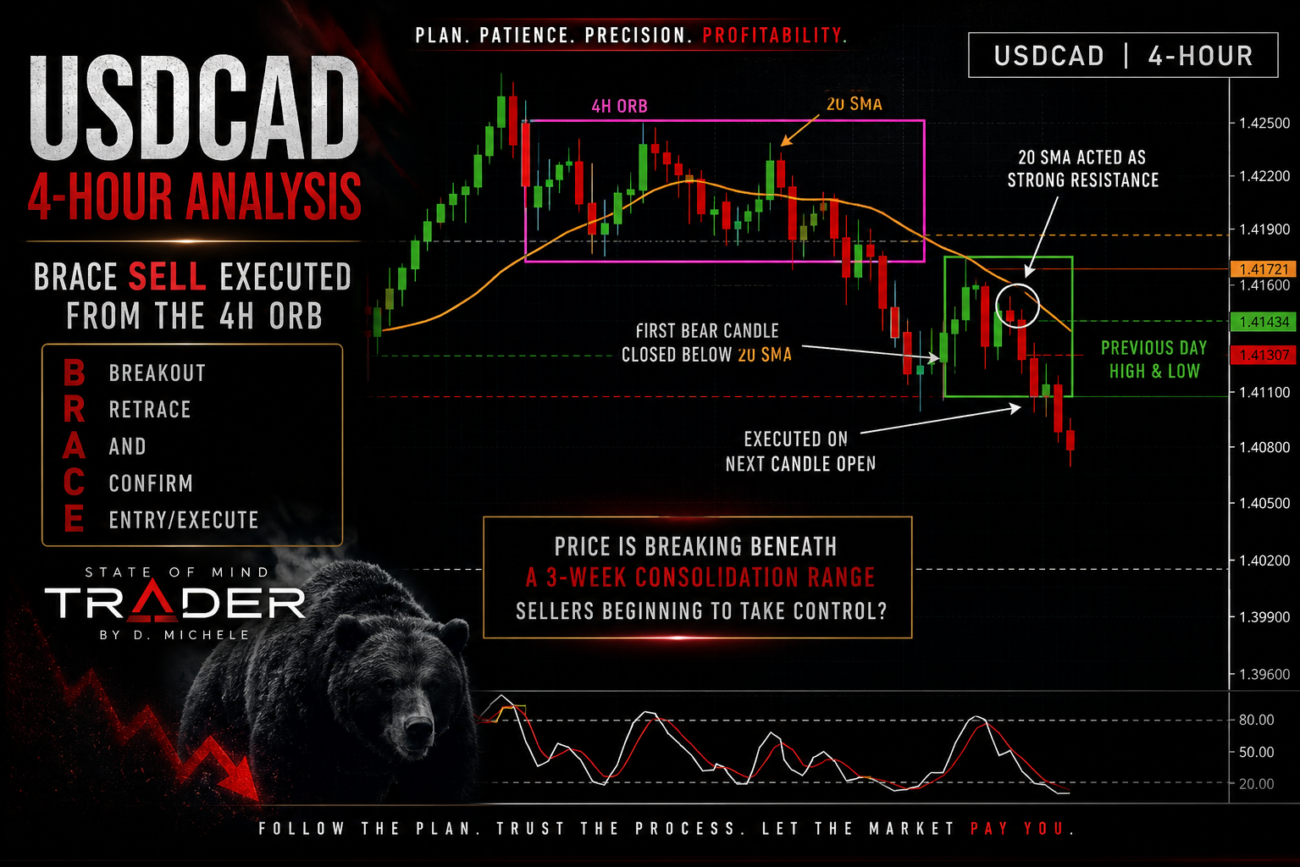
A BRACE sell executed from the 4-hour Opening Range Box (pink) as price breaks below the previous day’s range (green) and begins testing the lower boundary of a three-week consolidation.
One of the things I continually emphasize is that successful trading isn’t about chasing candles—it’s about waiting for the market to meet your conditions. The sell position I’m currently holding on USDCAD is a perfect example of that philosophy.
This trade wasn’t based on emotion or a prediction. It was executed by following my BRACE methodology using the 4-hour Opening Range Box (ORB) as my framework. Because the entire setup developed on the 4-hour chart, I also chose to execute directly from the 4-hour timeframe rather than dropping down to a lower timeframe.
For those who may be new to my analysis, BRACE stands for:
- Breakout
- Retrace
- AND
- Confirm
- Entry/Execute
Every step must occur in that order before I ever consider entering a trade.
Why I Took the Sell
The first thing that caught my attention was the breakout below my 4-hour Opening Range Box (ORB), represented on the chart by the pink rectangle. That fulfilled the first requirement of BRACE.
Rather than entering immediately, I waited patiently for price to retrace back toward the breakout area. This is where many traders become impatient, but I’ve learned over the years that allowing price to come back often provides higher-quality entries with much better risk management.
Adding even more confidence to the setup was the previous day’s high and low, represented by the green box extending into the current trading day. Once price moved below the previous day’s low, it provided additional confirmation that sellers were beginning to gain control.
What made this setup even stronger was the behavior of the 20-period Simple Moving Average. As price retraced, the 20 SMA acted as dynamic resistance, rejecting the pullback and preventing buyers from regaining control. When the first bearish candle closed beneath the 20 SMA, it provided the confirmation I was waiting for. Following my trading plan, I executed the sell at the open of the very next candle, completing every step of my BRACE methodology.
There was nothing random about this entry. Every piece of the puzzle came together before I committed capital.
A Much Bigger Picture Is Beginning to Develop
What makes this trade even more interesting is the larger market structure that is beginning to unfold.
Over the past several weeks, USDCAD has spent much of its time trading sideways inside what appears to be a three-week consolidation range. Markets simply cannot remain in equilibrium forever. Eventually, one side gains control.
Price is now beginning to push beneath the lower boundary of that range while also trading below the previous day’s range. That alignment between the break of the three-week consolidation and the break below the previous day’s low adds additional weight to the bearish case. While I never assume a breakout will automatically continue, a sustained move beneath both areas would suggest sellers are beginning to take control of the next leg lower.
One thing I always teach is that confluence matters. When multiple pieces of market structure begin telling the same story, I pay closer attention. In this case, the break below the 4-hour ORB, the move beneath the previous day’s low, the rejection from the 20 SMA, and the potential break of a three-week consolidation are all pointing in the same direction. That doesn’t guarantee the trade will continue lower, but it does provide a much stronger case than relying on any one signal by itself.
What I’m Watching Next
Although I’m currently in the trade, I’m not assuming the market owes me anything.
I want to see sellers continue defending the breakout below the 4-hour ORB while price remains beneath the 20 SMA, the previous day’s range, and the three-week consolidation. As long as those levels continue to act as resistance, I’ll simply continue managing the position according to my trading plan.
If buyers regain control and force price back above the 20 SMA or back inside the consolidation range, the market will simply provide new information, and I’ll respond accordingly. Good traders don’t argue with the market—they listen to it.
Final Thoughts
One of the biggest lessons I’ve learned is that consistency comes from following your process, not from trying to predict the future.
Whether this trade becomes a small winner or develops into a much larger move isn’t something I can control.
What I can control is executing my plan with discipline every single time.
That’s exactly what BRACE is designed to do.
Every chart tells a story. My job isn’t to write the story—it’s to read it objectively and wait for the market to present an opportunity that aligns with my rules. This USDCAD setup is simply another example of trusting the process and allowing discipline to take precedence over emotion.
Trade well, stay patient, and always let the market earn your entry.
— D. Michele
State of Mind Trader
