
As traders, growth doesn’t come from constantly searching for new strategies. It comes from refining what already works and eliminating what introduces inconsistency.
Over time, I’ve developed and taught the BRACE method—a structured approach built around break, retest, and confirmation. It remains a solid and reliable way to engage the market, especially for traders learning discipline and patience.
However, through continued backtesting and real market observation, I’ve refined my personal execution even further.
This refinement led to the development of what I now call:
The ACE Framework – A Multi-Timeframe EMA System for Precision Entries and Structured Trade Management
Why I Evolved Beyond BRACE
The BRACE method requires traders to:
- Manually mark zones
- Identify key levels using structure and boxes
- Wait for price to break and retest those levels
While effective, there is still a level of subjectivity involved.
Two traders can look at the same chart and draw slightly different zones.
That small difference can lead to:
- Missed entries
- Early entries
- Or unnecessary hesitation
What I began to notice was this:
Price was consistently reacting to levels I had not drawn… but those levels were clearly defined by higher timeframe EMAs.
Instead of asking:
“Where should I draw my levels?”
I started asking:
“Where is the market already telling me the levels are?”
What Is the ACE Framework?
ACE is a multi-timeframe system that uses higher timeframe EMA zones for structure, lower timeframe precision for entry, and progressive timeframe management to maximize profit.
A – Assess
- Identify higher timeframe EMA zones (4H, Daily, Weekly, Monthly)
- Mark confluence areas
- Check stochastic position
At this stage, no trade is taken.
The only question is:
“Is price approaching a meaningful level under the right conditions?”
C – Confirm
- Stochastic must already be overbought or oversold
- Price must touch a higher timeframe EMA level
- There must be clear rejection (wicks and failure to continue)
If it is not obvious, it is not tradable.
E – Execute (Refined Entry and Trade Management)
Step 1: Entry (30-Minute Precision)
- Wait for rejection at the EMA level
- Allow a confirmation candle to close
- Ensure the candle is not oversized
- Enter immediately after the close
Step 2: First Target (Secure the Trade)
- Target minimum 1:2 RR
- Or take partials at structure
- Move stop loss to break even
Step 3: Promote the Trade (Position Management)
- Shift to higher timeframe structure (1H → 4H)
- Trail stop based on swing highs/lows
- Allow the trade to expand naturally
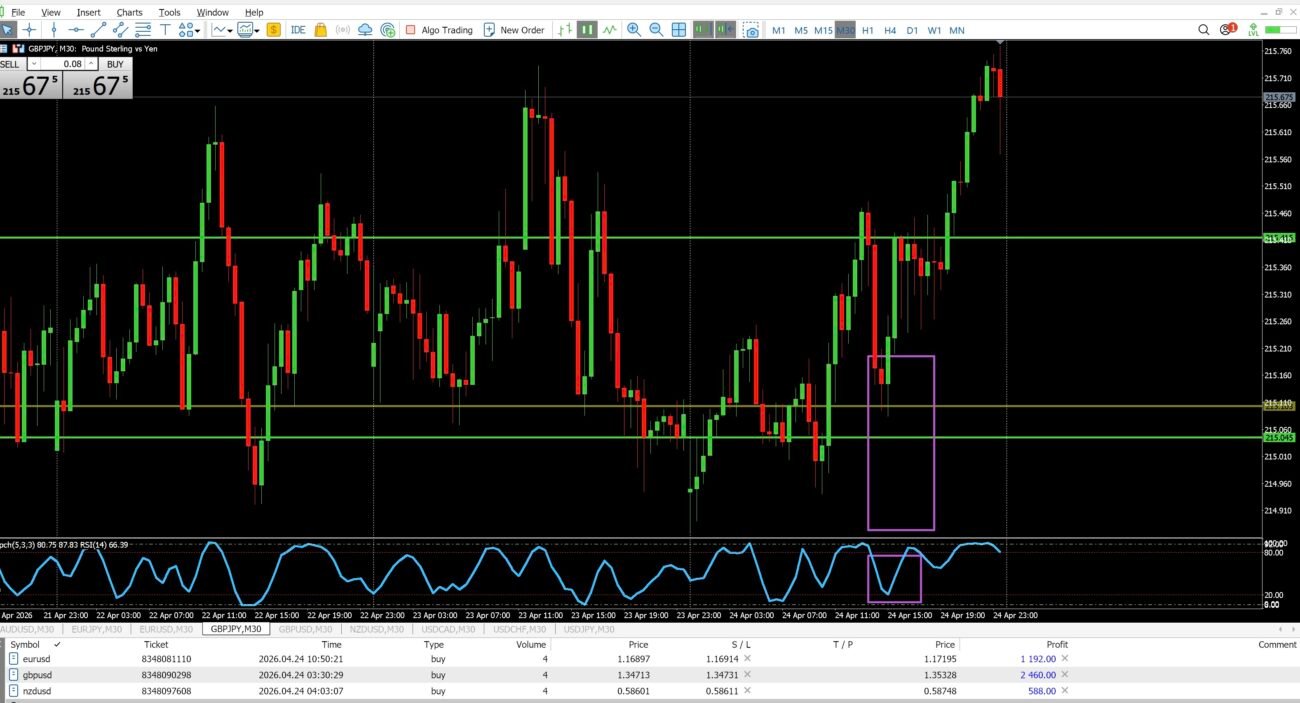
📊 Real Market Example: GBPJPY 30-Minute Buy Setup
The chart below illustrates a clean ACE buy setup using GBPJPY on the 30-minute timeframe.
Price retraced into a higher timeframe EMA zone, specifically the 4 hr 50 EMA, which acted as a dynamic support level. At the same time, stochastic conditions were already in the oversold zone, satisfying the first requirement of the system.
As price reached this level, it did not drift or hover—it touched the EMA zone and showed clear rejection, evidenced by wicks and the inability to continue lower.
This is where discipline matters.
There was no anticipation. No early entry.
Only after a bullish confirmation candle closed on the 30-minute timeframe was the trade executed.
From there:
- Stop loss was placed below recent structure
- Initial target was set at a 1:2 risk-to-reward
- Once achieved, the position could be secured and managed for continuation
This example highlights the core strength of the ACE framework:
The level was not drawn manually.
It was already defined by higher timeframe structure.
The trader’s role was simply to:
- Recognize the level
- Wait for confirmation
- Execute with precision
Why ACE Improves on BRACE
BRACE remains a strong method for understanding market structure and confirmation.
However, ACE refines the process by:
- Removing subjective level drawing
- Using EMA zones as objective structure
- Improving entry precision on lower timeframes
- Providing a structured method for holding runners
Final Thoughts
The goal in trading is not complexity.
It is clarity and consistency.
The ACE Framework simplifies decision-making by focusing only on what the market is already showing.
If it meets the criteria, execute.
If it does not, leave it alone.
