
In trading, patience isn’t just a virtue—it’s protection.
One of the most common mistakes traders make is entering a trade the moment price breaks a zone. It feels right. It looks powerful. And sometimes… it even works.
But here’s the truth:
that first break is often the setup—not the entry.
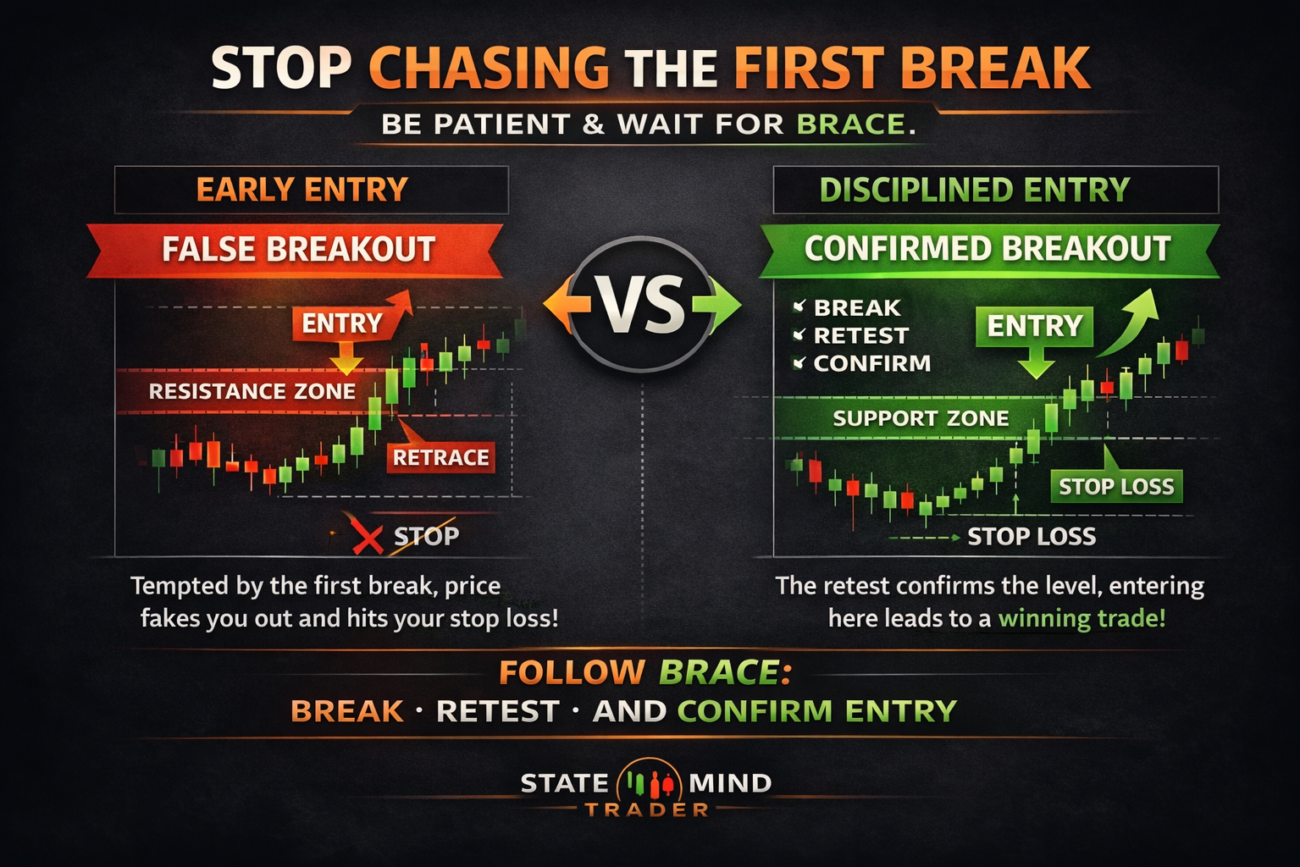
If you’re trading a structured method like BRACE (Break. Retest. And Confirm Entry.), skipping steps might give you a quick win here and there—but over time, it will quietly drain your account and destroy your consistency.
Let’s talk about why.
The Illusion of the First Break
When price breaks a zone, it creates excitement. Momentum kicks in. Candles look strong. It feels like you’re about to “miss the move.”
That’s where traders get trapped.
Because what looks like a clean breakout is often just liquidity being taken before price does the opposite.
Here’s what typically happens when you jump in too early:
- Price breaks the zone aggressively
- You enter immediately
- Price pulls back (because it always tests structure)
- You get stopped out…
- Then price moves in your original direction without you
That’s not bad luck. That’s poor execution.
The market doesn’t reward impatience. It punishes it.
Why the Retest Matters
The retest is where truth is revealed.
Anyone can push price through a level temporarily. But when price comes back to that zone, that’s when you find out if the move was real—or just a fakeout.
The retest does three critical things:
- Confirms the level is respected
If price returns and holds, the zone is valid. - Filters out false breakouts
If price collapses back through the zone, you just avoided a bad trade. - Improves your entry price
Instead of chasing, you’re entering with precision.
Skipping the retest is like buying a house without inspecting it.
Sure… it might be fine. But when it’s not, you pay for it.
Confirmation: The Step Most Traders Ignore
Let’s be honest—most traders don’t lose because they don’t know what to do.
They lose because they don’t wait.
The confirmation candle is what separates guessing from execution.
This is where you look for:
- Strong rejection wicks
- Clean bullish or bearish closes
- Clear intent from price
Without confirmation, you’re not trading a setup—you’re trading a feeling.
And feelings don’t belong anywhere near your trading account.
The Discipline of BRACE
BRACE is not just a strategy—it’s a process.
- Break – Price moves through a zone
- Retest – Price returns to test that zone
- And Confirm – Market shows its hand
- Entry – You execute with confidence
Each step exists for a reason.
When you skip one, you’re no longer trading BRACE.
You’re freelancing.
And freelancing in the market is expensive.
“But It Worked Last Time…”
Ah, yes. The most dangerous sentence in trading.
Just because you entered on the first break and made money does not mean it was a good trade.
Let’s say that again clearly:
A profitable trade that breaks your rules is still a bad trade.
Why?
Because you’re reinforcing bad habits.
Trading is a game of repetition. Whatever you practice consistently—good or bad—becomes your default behavior.
So if you keep getting rewarded for breaking your rules, eventually:
- You’ll size up
- You’ll get overconfident
- You’ll take a larger loss when it doesn’t work
And trust me—it won’t always work.
Redefining What a “Good Trade” Really Is
This is where most traders get it backwards.
They judge trades based on outcome instead of execution.
Let’s fix that.
A Good Trade:
- Follows your rules
- Respects your strategy
- Uses proper risk management
- Is executed with discipline
Even if it loses.
A Bad Trade:
- Breaks your rules
- Is based on impulse
- Ignores your system
- Is emotionally driven
Even if it wins.
If you don’t understand this, you’ll never become consistent.
Because consistency isn’t built on wins—it’s built on repeatable behavior.
Losing Trades Are Part of the Game
Here’s another truth most people don’t want to hear:
You will lose trades.
No strategy—not even BRACE—is 100% accurate.
And that’s perfectly fine.
A losing trade doesn’t mean your strategy failed.
It means you’re participating in a probability-based system.
The goal is not to win every trade.
The goal is to:
- Protect your capital
- Maintain discipline
- Stay consistent over time
If you follow your rules and take a loss, that’s a professional loss.
If you break your rules and win, that’s an amateur win.
One builds longevity. The other builds bad habits.
The Long-Term Cost of Impatience
Entering on the first break might feel like you’re being aggressive and decisive.
But over time, it leads to:
- Increased drawdown
- Emotional trading
- Inconsistent results
- Loss of confidence
Why?
Because you’re removing the structure that protects you.
The market will always tempt you to move early.
It’s designed that way.
But your job as a trader is not to react—it’s to execute.
Final Thoughts: Trade Like a Professional
At the end of the day, trading is not about catching every move.
It’s about catching the right moves, the right way, over and over again.
BRACE gives you that structure.
It slows you down.
It filters bad trades.
It protects your capital.
And most importantly—it builds discipline.
So the next time you see that first break and feel the urge to jump in…
Pause.
Wait for the retest.
Wait for the confirmation.
Then execute.
Because in this game, patience doesn’t just pay…
It protects.
